When the Seed Never Made It: Lessons from Drilling Soybeans in Heavy Residue

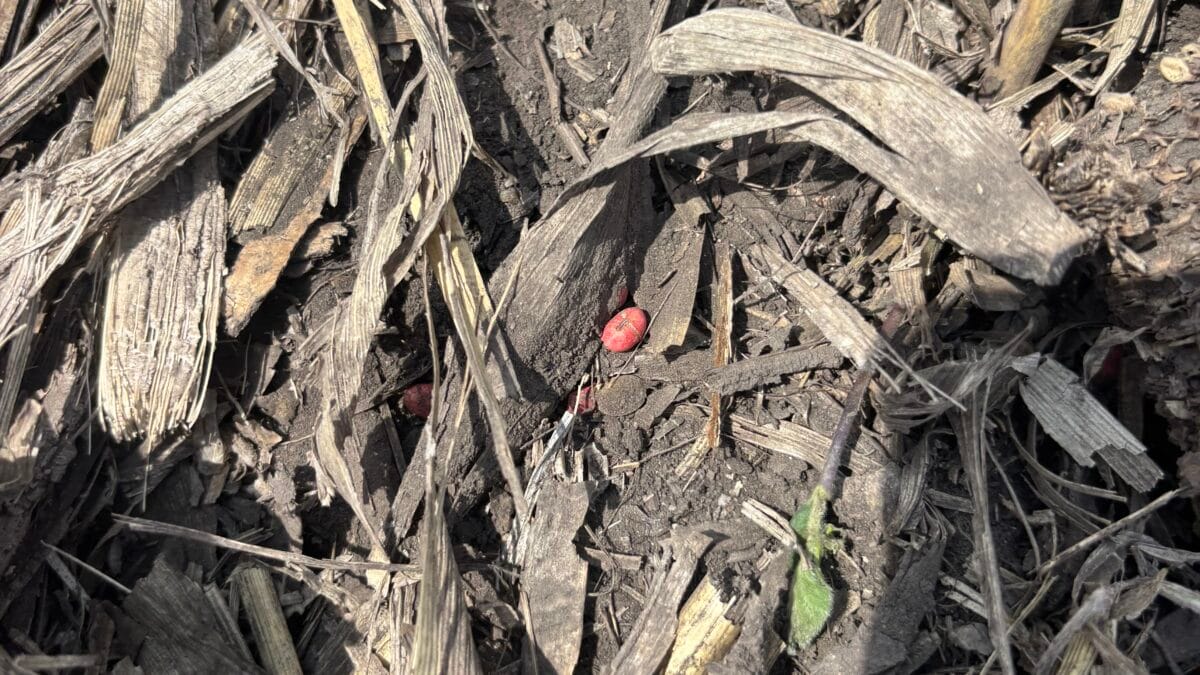
One of the most consistent soybean stand issues I saw in 2025 didn’t come back to seed quality, germination or even disease pressure. It came back to something much simpler: the seed never made it into the ground.
Fields drilled into heavy corn residue were where the problems showed up most clearly. In several cases, soybeans looked like they had been planted, but when we dug, seed placement just wasn’t there. And when seed placement is wrong, nothing else matters. You can’t evaluate emergence, nodulation or yield potential if the seed never had a chance to establish.
What I Saw in the Field

When drilling into heavy residue, growers risk ‘planting’ beans that do not make it into the soil.
Across the board, hoe drills outperformed disc drills in heavy residue situations. Hoe drills created a defined trench and placed seed consistently, even when residue levels were high. Disc drills struggled to cut through thick corn residue, especially in drier topsoil conditions like we saw around the north-central North Dakota area.
That combination of heavy residue and dry soils led to hair-pinning of residue, shallow or inconsistent depth and seed sitting on top of the residue instead of in the soil.
In many of these fields, the planter or drill looked like it was doing its job. From the cab, everything seemed fine. But once we got out and checked, the problems were obvious.
The Habit That Hurt Stands
Here’s the honest part: we tend to be far more disciplined about checking corn planting depth than soybean placement. On the corn side, it’s routine to stop, dig and verify. On the soybean side, it’s common to fill the drill, plant 200 units and assume the crop will “figure it out.”
In 2025, that assumption cost stands.
Why It Happened in 2025
Several factors stacked together:
✔ Heavy corn residue that disc openers couldn’t cut
✔ Dry surface soils limiting penetration
✔ Uneven residue distribution from harvest
✔ Residue bunching or floating
✔ Fewer in-field checks once planting started
✔ A false sense of security that soybeans are “easy to plant”
None of these issues alone are unusual, but together, they created widespread placement problems.
What Growers Can Do Differently in 2026
- Match the drill to the residue. Hoe drills handle heavy residue better. Disc drills can work, but conditions need to be close to ideal.
- Start with better residue distribution. A small improvement at harvest – better spreading, fewer windrows – makes spring drilling significantly easier.
- Anchor residue where possible. Light vertical tillage or residue managers can help keep residue from floating and interfering with placement.
- Stop and check more often. Check when switching fields, when conditions change and after overnight shutdowns. What worked yesterday may not work today.
- Verify placement—not just depth. Dig seed. Confirm it’s in the trench, covered with soil and not riding on residue.
My Takeaway for 2026
Soybeans deserve the same planting attention we give corn. Nearly every poor soybean stand I evaluated in 2025 traced back to seed placement: not genetics, not weather, not disease.
If the seed gets into the ground where it belongs, everything else improves: emergence, uniformity, nodulation and yield potential.
Slowing down enough to verify placement is one of the simplest ways to protect yield next season. A few checks behind the drill can save a lot of bushels.
Use our Find Your Fit tool to match soybean varieties to your ground: https://www.petersonfarmsseed.com/products/soybeans/find-your-fit/