Common Corn Diseases in Our Region and How to Manage Them

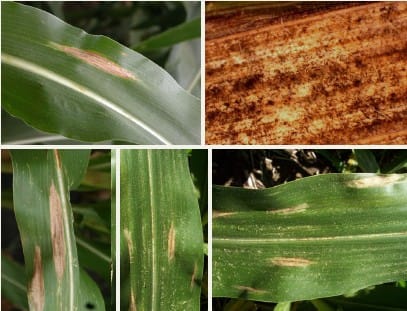
As corn acres across the region have increased, so has the disease pressure. In North Dakota alone, corn acres have increased from 1 million to around 4 million acres since 2000.
The climate continues to change at the same time, and as it has become warmer and wetter, disease pressure has risen. Here is a list of commonly found diseases and management strategies for limiting the economic impact of these diseases.
TAR SPOT
 How to spot: Small, raised black lesions that don’t rub off. Often surrounded by yellowing tissue as the disease progresses. It literally looks like someone splattered the plant with tar.
Prefers: Moderate daytime temps (60-70F) with cool nights and relatively high humidity (>70%RH). Extended leaf wetness (>7 hours). It does overwinter in fields with tar spot history.
Of concern: Reduces photosynthesis, leading to early plant shutdown and lost yields.
Look-a-like: Insect droppings or dirt, which will rub off.
How to manage:
• Use hybrids with better tar spot tolerance where risk is higher
• Apply preventive fungicides, preferably at VT-R1
• Use multiple modes of action
• Scout early and often due to long latent period
• Rotate to nonhost crop in any field with previous history of tar spot
NORTHERN CORN LEAF BLIGHT

How to spot: Long (usually 1”-6”), gray-green to tan, cigar-shaped lesions usually appearing on the lower leaves first and moving up the plant canopy as disease develops.
Preferences: Moderate temps (65-80F) and frequent rain or heavy dew (>6 hours daily).
Of concern: Reduces effective photosynthetic leaf area, which can limit yield.
Look-a-like: Gray leaf spot, which has more rectangular lesions bounded by leaf veins.
How to manage:
• Use hybrids with good tolerance
• Manage residue to reduce inoculum in the soil
• Apply fungicides before the upper canopy becomes infected
SOUTHERN RUST
 How to spot: Bright orange to rust-colored pustules that rub off easily; primarily found on the top of leaves.
Preferences: Heat (+80F) and humidity – needs weather systems to push the spores north annually as it doesn’t overwinter in our region.
Of concern: Can spread rapidly, causing loss of green leaf area during grain fill.
Look-a-like: Common rust, which is darker, more scattered and found on both sides of leaves.
How to manage:
• Increase scouting during periods of heat and humidity
• Apply fungicides when disease is detected
• Plant hybrids with a good natural tolerance
COMMON RUST
 How to spot: Small, brick-red to cinnamon-brown pustules on both sides of the leaf that release powdery spots when ruptured.
Preferences: Cool (65-70F) and moist environments; often arrives earlier in the season than southern rust. Overwinters in tropical regions and moves in on the wind similar to southern rust.
Of concern: Usually low impact to yield unless unusually heavy and early in the season.
Look-a-like: Southern rust, whose pustules are more orange and confined to the top of the leaf.
How to manage:
• Most fields don’t require treatment
• Consider fungicides only if severe pressure develops early or increases rapidly
• Seed corn field/inbreds are most susceptible to common rust
GOSS’ WILT

How to spot: Caused by bacterial infection. Water-soaked lesions with dark freckles and a shiny, varnished appearance. Infected lesions will have wavy edges.
Preferences: Bacteria can infect plant through the stomata or injury from hail, wind/etc., followed by warm temps.
Of concern: Infection can reduce grain fill and cause premature plant death.
Look-a-like: Northern corn leaf blight, which lacks dark freckles and water-soaked margins.
How to manage:
• Select tolerate hybrids
• Reduce residue to minimize plant injury in high-wind events
• No effective in-season chemical control available