Common Soybean Diseases in Our Region and How to Manage Them

The following soybean diseases are the ones we most commonly identify across North Dakota, South Dakota and Minnesota. Pressure varies year to year, but understanding how to recognize them, and when they matter, helps us make better placement and management decisions.
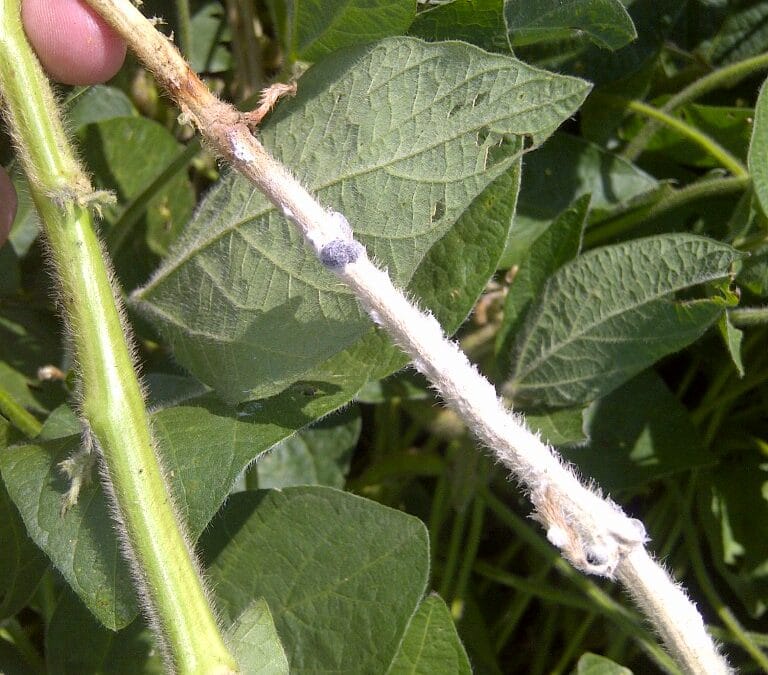
WHITE MOLD (Sclerotinia)
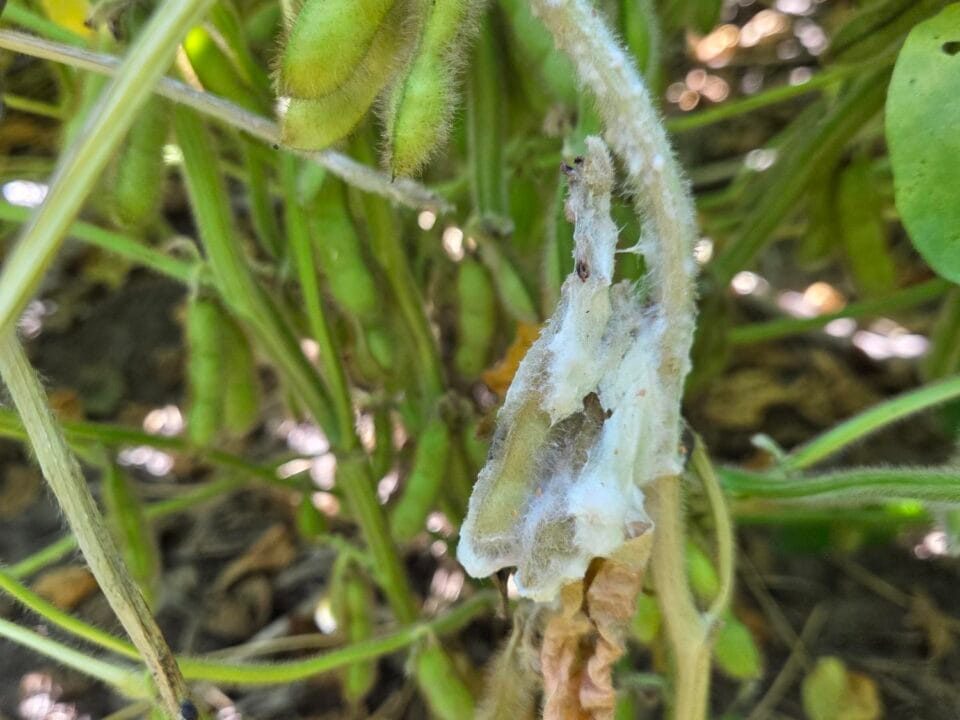
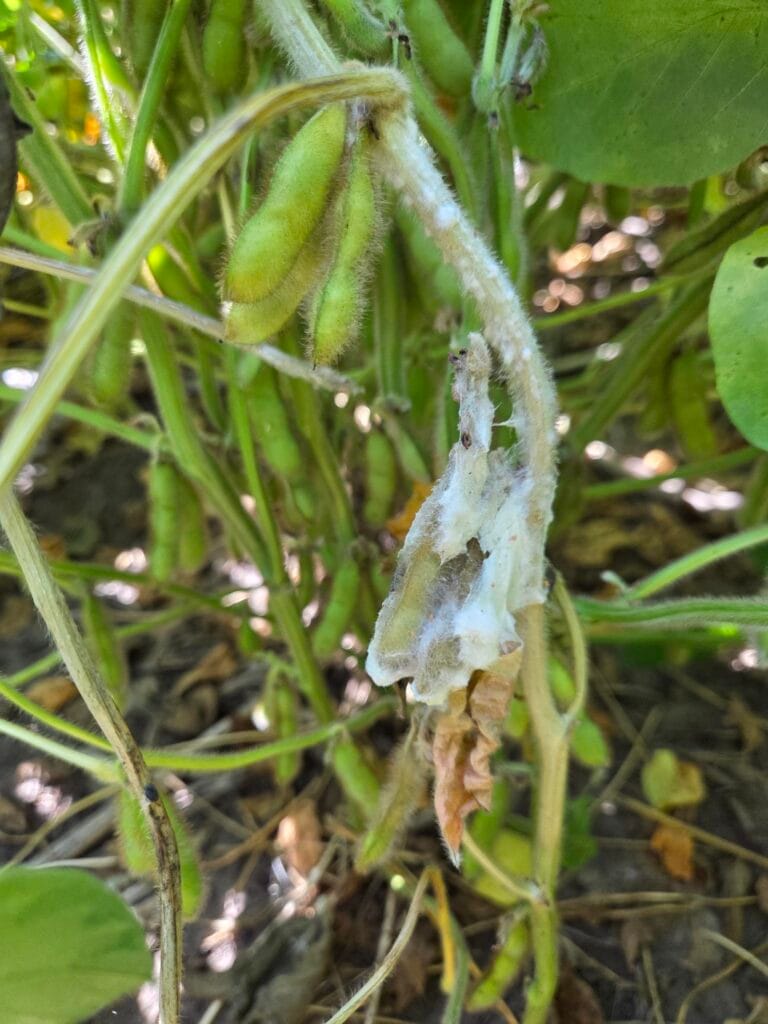
 How to spot: Wilted plants with white, cottony growth on stems or branches. Black sclerotia may be present inside stems.
Prefers: Dense canopies where airflow is constricted, paired with cool, wet conditions during flowering. Especially prevalent in high-yield environments.
Why it matters: White mold can cause direct plant loss and reduced pod set, especially in fields with a history of disease.
Commonly confused with: Stem canker or brown stem rot, which don’t produce white mold growth or sclerotia.
Management considerations:
- Place varieties with stronger white mold tolerance in higher-risk fields
- Manage canopy density through population, row spacing, and plant structure
- Time fungicides carefully at R1–R3 when risk is elevated
- Use weather-based risk tools to support application decisions
PHYTOPHTHORA ROOT AND STEM ROT

Photo credit: Jeff Miller – Agronomy Specialist, CCE Oneida County
How to spot: Stand gaps plus weak, yellow seedlings in low spots. Seedlings may rot and collapse soon after emergence. In-season, plants can wilt and die with a brown stem lesion that often progresses upward from the soil line.
Prefers: Saturated or poorly drained soils; heavy rains after planting; compacted areas and low spots where water stands.
Why it matters: One of the most yield-limiting soybean diseases in wetter environments because infection can start early and persist through the season.
Commonly confused with: Rhizoctonia, which has a distinct pinched, sunken lesion at the soil line.
Management considerations:
- Select varieties with phytophthora genes AND a strong field tolerance; both are important.
- Prioritize field fit: drainage improvements, compaction reduction, and avoiding “mudding in” soybeans when soils may remain saturated.
- Use a seed treatment package that includes protection aimed at water-mold pathogens where risk is higher.
- Flag high-risk fields (history + low areas) so you can scout earlier and confirm stand loss causes quickly.
BROWN STEM ROT (BSR)
 How to spot: Brown discoloration inside the stem pith when split lengthwise; foliar symptoms resemble SDS.
Prefers: Cool temperatures and moist conditions later in the season.
Why it matters: BSR restricts internal water movement, which can impact pod fill.
Commonly confused with: SDS, which affects roots rather than the internal stem tissue.
Management considerations:
- Place BSR-resistant varieties in known problem fields
- Rotate crops
- Manage residue where practical
BACTERIAL BLIGHT
 How to spot: Angular, water-soaked lesions that may tear, giving leaves a ragged appearance.
Prefers: Cool, wet weather early in the season; wind-driven rain.
Why it matters: Usually cosmetic; yield impact is typically limited.
Commonly confused with: Frogeye leaf spot, which has round lesions with defined margins.
Management considerations:
- Minimize field traffic when plants are wet
- No effective in-season chemical control
FROGEYE LEAF SPOT

Photo credit: Daren Mueller
How to spot: Round lesions with gray centers and dark margins, usually on upper leaves.
Prefers: Warm, humid conditions; soybean residue.
Why it matters: Frogeye leaf spot can reduce photosynthetic leaf area when it moves into the upper canopy.
Commonly confused with: Bacterial blight, which has more angular lesions.
Management considerations:
- Select resistant varieties
- Rotate crops and manage residue
- Consider fungicides if pressure is significant and timing is appropriate
SUDDEN DEATH SYNDROME (SDS)
 How to spot: Interveinal yellowing that turns brown while veins remain green; roots show rot and reduced nodulation.
Prefers: Cool, wet soils early in the season; compacted or poorly drained areas.
Why it matters: SDS limits late-season water and nutrient uptake, which can reduce yield even when stands look good early.
Commonly confused with: Brown stem rot, which has similar vegetative symptoms, but can be differentiated by examining the inner plant stem (pith).
Management considerations:
- Use varieties with strong SDS tolerance
- Protect seedlings with appropriate seed treatments
- Avoid planting into cold, saturated soils when possible
- Improve drainage and reduce compaction where feasible
- Monitor SCN populations that can exacerbate SDS yield loss
SEPTORIA BROWN SPOT

Photo credit: Dean Malvick, University of Minnesota
How to spot: Small brown spots starting on lower leaves and moving upward late in the season.
Prefers: Warm, humid conditions; areas of heavy residue.
Why it matters: Typically, low yield impact unless it reaches the upper canopy early.
Commonly confused with: Bacterial blight, which typically appears earlier, has more angular, water-soaked lesions and is often associated with cool, wet weather
Management considerations:
- Crop rotation and residue management
- Fungicides are rarely economical unless pressure is unusually heavy
RHIZOCTONIA
 How to spot: Seedlings that emerge and then “pinch off.” Look for reddish-brown, sunken lesions at or just below the soil line; plants may lodge or snap easily at the lesion.
Prefers: Warm-to-moderate soils; planting into stressed conditions; situations that slow emergence and early growth.
Why it matters: Often shows up as uneven stands and weak plants that never catch up, especially when early-season stress stacks up.
Commonly confused with:
- Mechanical injury (openers, crusting, sandblasting, residue movement)
- Fusarium (different root discoloration and decay patterns)
Management considerations:
- Improve seedbed consistency and reduce stress that delays emergence
- Use a balanced seed treatment appropriate for planting conditions
- Dig multiple plants across both good and poor areas before assuming seed quality issues
CHARCOAL ROT

Photo credit: Steve Holzbauer
How to spot: Gray discoloration of stems and roots; fine black microsclerotia inside stem tissue.
Prefers: Hot, dry conditions during reproductive stages.
Why it matters: Can cause premature plant death in drought-stressed fields.
Commonly confused with: Brown stem rot, which occurs under cooler conditions and lacks microsclerotia.
Management considerations:
- Reduce stress through population and fertility management
- Use tolerant varieties where risk is present
- Manage compaction and moisture stress
PYTHIUM

Three soybean seedlings showing root rot from pythium, compared with five healthy seedlings on the right. Photo credit: NDSU
How to spot: Classic early stand issues. Seeds may rot before emergence; seedlings appear soft and watery, especially in saturated zones.
Prefers: Cool, wet, saturated soils, especially when seedlings experience oxygen stress.
Why it matters: Pythium hits early, is opportunistic and has no known genetic resistance, making management largely preventative.
Commonly confused with: Phytophthora, which may persist later in the season and show stem lesions.
Management considerations:
- Avoid planting when soils are likely to remain cool and wet after planting
- Use seed treatments designed to address early-season water molds
- Compare the field’s low spots to better-drained areas to confirm moisture-driven patterns
FUSARIUM

Photo credit: Mike Stanyard, Cornell University
How to spot: Often appears as general seedling stress or root and crown rot. Symptoms can be subtle early and intensify when plants are compromised.
Prefers: Heavy soils, poor drainage, high manure environments and any situation that injures roots (including insect feeding).
Why it matters: Fusarium is difficult to manage because it includes many species and often reflects stacked stresses rather than a single cause.
Commonly confused with:
- Rhizoctonia (pinching lesions near the soil line)
- Pythium or phytophthora when moisture is the primary driver
Management considerations:
- Treat fusarium as a stress-management disease by improving drainage and reducing compaction
- Stack multiple modes of action in seed treatment where early-season risk is high
- Use scouting to separate slow emergence from true disease-driven stand loss and adjust future field plans accordingly
Use our Find Your Fit tool to match soybean varieties to your ground: https://www.petersonfarmsseed.com/products/soybeans/find-your-fit/