Cold Shock at Planting: How to Prevent Imbibitional Chill in Corn and Soybeans

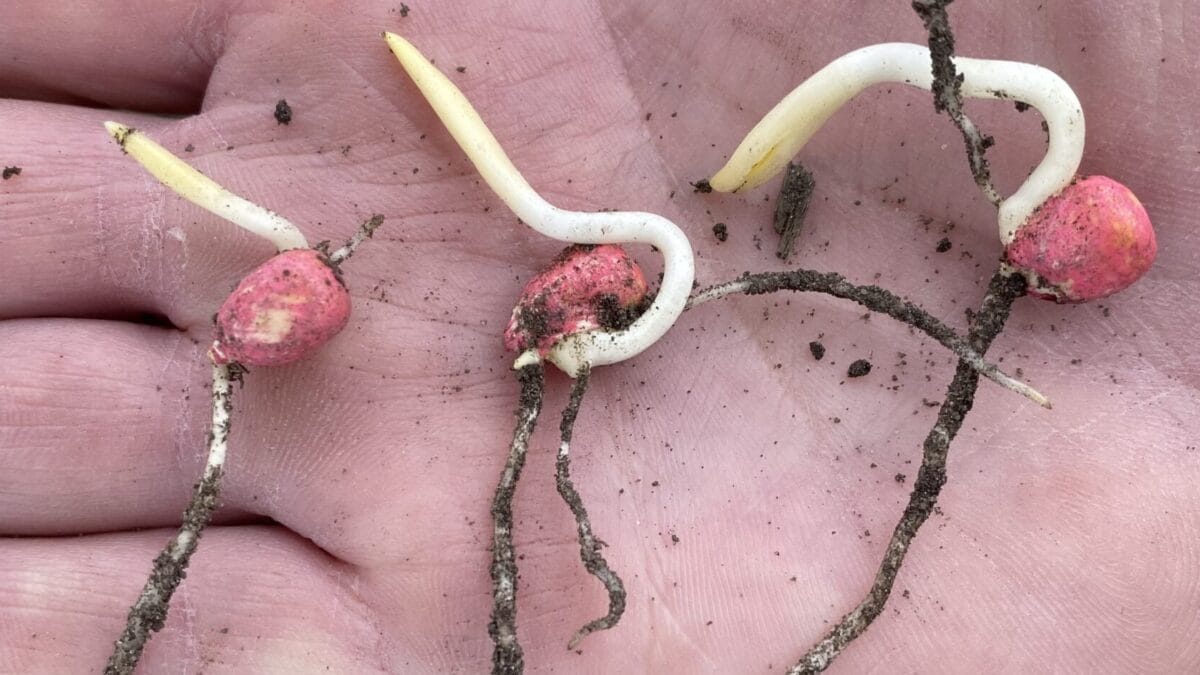
Last spring gave us close to a worst-case scenario for imbibitional chill.
Planting started under excellent conditions. Soils were fit, planters were running well and there was a strong push to get acres covered. Then, within a day or two of planting, we caught a cold rain followed by several days with highs in the 30s and low 40s. That timing is exactly when imbibitional chill becomes a problem.
From a soil temperature standpoint, 50 degrees Fahrenheit and rising is the ideal scenario. When planting occurs with temperatures below 50 and cold rain follows, the risk of imbibitional chill significantly increases. Any planting window with sub-50 degree soils, especially when precipitation is forecast shortly after planting, raises the likelihood of chilling injury.
What Is Imbibitional Chill?
Imbibitional chill occurs when a dry seed takes up very cold water during its initial moisture uptake. That first 24–48 hours after planting is critical. If the first water the seed absorbs is cold, it can disrupt cell membranes, reduce vigor, distort emergence and in some cases kill the seed outright.
Most people associate this issue with corn, but soybeans are actually more sensitive. Soybeans have a thinner seed coat and are often planted shallower, which means cold moisture reaches them faster and with less buffering from soil temperature.
What I Saw in 2025

In 2025, the symptoms were widespread and consistent. Corn plants showed corkscrewed mesocotyls and, in some cases, leafed out underground (A) as they
struggled to orient themselves. Soybeans (B) often emerged with twisted or looped hypocotyls that never straightened.
Stand counts were well below expectations in several fields, and emergence was highly uneven, putting those acres behind from the start. Once that damage occurs, there’s no corrective treatment. Every management decision for the rest of the season is made with a compromised stand.

The effects of imbibitional chilling showed up in this field in the form of uneven emergence due to the cold planting conditions.
What I Recommend Going Forward
The goal isn’t to avoid early planting entirely; it’s to avoid planting into conditions that set the crop up for failure. With the forecasting tools available today, I strongly encourage using multiple weather sources to stay ahead of changing conditions.
1. Respect soil temperature and the short-term forecast.
As a general guideline, I want soil temperatures at 50°F and rising for both crops. For soybeans, I recommend avoiding planting within 24 hours of a forecasted cold rain. For corn, extend that window to 36 hours. The temptation to “plant until the rain hits” is understandable, but if seed is still dry when the front arrives, that cold rain becomes its first drink, and that’s when injury happens.

This corn grew down into the soil instead of up to the soil surface due to the chilling effect.
2. Protect early soybeans with seed treatment.
Soybeans planted early into cold, wet soils are more vulnerable to both chilling injury and early-season pathogens. A solid seed treatment package doesn’t prevent imbibitional chill, but it helps protect weakened seedlings from diseases that compound the stress. That’s a key reason we’ve broadened our treatment offerings at Peterson – specifically, our treatments for rhizoctonium and pythium. With Peterson Select, we use multiple modes of action designed to target these early season diseases.
3. Scout and dig after cold events.
Three to four days after a cold rain or cold snap, get out and dig. Check how seedlings are developing below ground and compare emerged plants to what was planted. The sooner we know a stand is compromised, the sooner we can make informed replant or management decisions.
Early planting still has value. But there’s a clear difference between planting early and planting into conditions that invite cold shock.
Imbibitional Chill: Field Guidelines
✔ Target 50°F and rising soil temperatures
✔ Avoid planting soybeans within 24 hours of a forecasted cold rain
✔ Avoid planting corn within 36 hours of a forecasted cold rain
✔ Use extra caution in high-residue and no-till systems
✔ Dig and evaluate seedlings after cold events