What’s Really Causing IDC in Your Fields and How to Manage the Risk
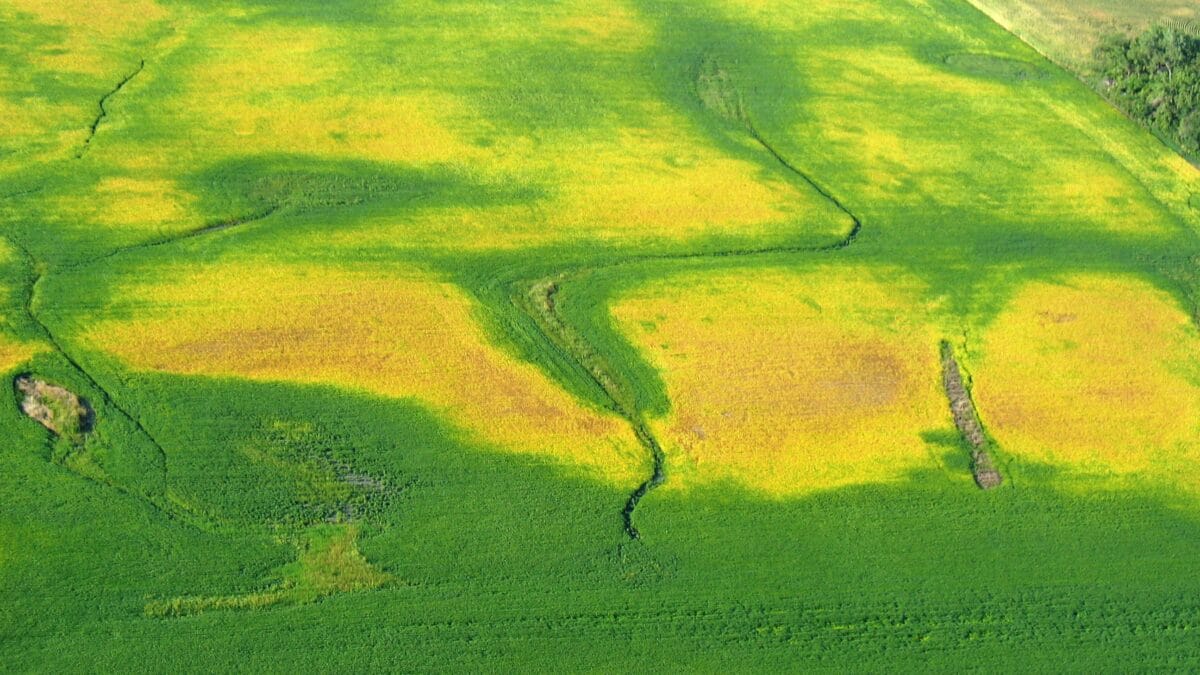
Iron deficiency chlorosis (IDC) is nothing new across the Dakotas and Minnesota. The 2025 growing season, however, gave us plenty of reminders of how severe IDC can be when the right conditions line up. In many fields, pressure was high enough to significantly impact stand vigor and early yield potential.
What Drives IDC?
IDC develops when soil pH levels reach 7.5 or higher WITH high levels of carbonates and salts. It’s important to understand that high pH alone does not automatically result in severe IDC. Many high-pH soils show little to no chlorosis.
Salts and carbonates are the key contributors:
Salts (Salinity)

- Increase plant stress and limit the accessibility of iron
- Interfere with nutrient and water uptake
- Increase IDC risk when combined with high soil pH
- Compound IDC severity when nitrate levels are high
Carbonates
- Directly tie up iron in the soil
- Neutralize root exudates (acids)
- Limit the plant’s ability to solubilize and absorb iron
- Compound IDC severity when nitrate levels are high
Nitrates and Identifying IDC Risk
Nitrates are a form of inorganic nitrogen that naturally occurs in soils. Common sources include plant residue, manure, chemical fertilizers and rainfall.
Soil testing provides the most foolproof way to understand IDC risk in a field. Agvise Laboratories offers detailed soil testing that helps identify the key drivers of IDC to help you understand your individual fields. For more information, visit www.agvise.com.
When soil sampling for IDC risk, focus on four primary measurements:
- Carbonate levels (CCE)
- Soluble salts
- Nitrates
- Soil pH
Together, these four factors drive the highest risk for severe IDC symptoms.

Visit www.agvise.com for more information.
When carbonate levels exceed 5% and soluble salt levels reach 0.5%, producing healthy soybeans gets tough.

Managing the Risk
Varietal Selection Comes First
Once IDC symptoms appear during the growing season, it’s too late to correct the issue for that year. The first three lines of defense against IDC are variety selection, variety selection and variety selection. That’s not a typo – I want to stress the importance of placing the right soybean on tough IDC acres. If you don’t start with a resistant variety, management options become very limited once symptoms develop.
At Peterson, we take varietal IDC research a step further than our competitors. During the growing season, when IDC hot spots emerge, our research team targets those areas with single-row IDC plots. This extra research effort during the growing season allows us to update product ratings from data gained in real-world IDC conditions. See related article on page 35.
Timing is critical. If we planted these plots early in the spring, IDC pressure might not develop in that exact location. By planting AFTER symptoms appear and in locations where we KNOW IDC exists, we can guarantee the best pressure possible to test our lineup’s ratings. And then we can confirm or adjust to ensure you can have confidence when you plant.
Spacing and Population
Several additional strategies can help manage IDC pressure. Wide row spacing combined with higher planting populations will result in more soybean plants, closer to each other, increasing root mass. A larger root system can improve tolerance to high pH, salts and carbonates.
Chelated Iron Fertilizers
 Chelated iron fertilizers, commonly known as Soygreen, can also help suppress IDC symptoms. Soygreen has been used for many years and remains one of the most effective tools available.
But watch out – not all iron fertilizers perform equally. Soygreen is an ortho-ortho FeEDDHA formulation, the most effective chelate for alleviating IDC symptoms in high-pH soils. Lower-cost alternatives, such as FeEDTA products, such as Rexolin, are lower cost for a reason. EDTA-based products are ineffective in the high pH soils (7.5 and up) common across our region.
One important reminder: chelated iron products need to be applied in the soil as they must be present in the root zone to work. Foliar applications are not effective as iron doesn’t move through leaf tissue and must be taken up by the roots.
Use our Find Your Fit tool to match soybean varieties to your ground: https://www.petersonfarmsseed.com/products/soybeans/find-your-fit/