Tar Spot Has Arrived: What We’re Seeing and How to Stay Ahead

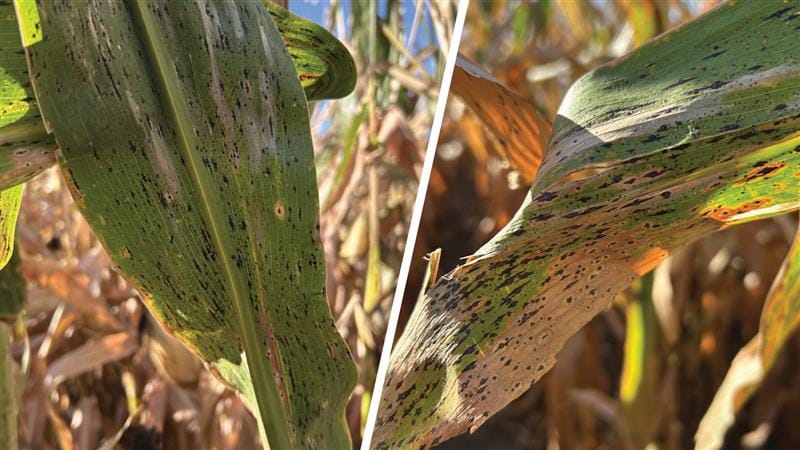
Tar spot used to feel like a disease we watched from a distance. However, in the last few seasons, it’s become something we actively scout for.
First confirmed in the Midwest in 2015, tar spot has steadily moved north. By 2024 and 2025, it was identified across eastern South Dakota, southeast North Dakota and the southern half of Minnesota. While most fields are still at low levels, the trend line is clear.
Why Tar Spot Concerns Me
Tar spot thrives under conditions we know well: moderate temperatures, high humidity and extended leaf wetness. These conditions are common in our region, especially during July and August.
Yield losses in southern Minnesota have already reached 20–60 bushels per acre in susceptible hybrids. That’s why early awareness matters. Tar spot has a long latent period. Infection can occur weeks before visible symptoms show up, which limits reaction time.
What to Look For
Tar spot appears as small, black, raised lesions that don’t rub off. In severe cases, leaf tissue can exceed 50% infection, accelerating plant death and reducing grain fill.
We’ve also confirmed that tar spot can overwinter in our geography, meaning past presence increases future risk.
Management That Works

1. Hybrid selection matters. Avoid highly susceptible hybrids in higher-risk fields. Tolerance scores are becoming more reliable each year. Check out our lineup.
2. Fungicides are effective when timed correctly. Products with multiple modes of action consistently perform best. No single chemistry stands out on its own.
3. Timing is critical. Applications around VT–R1 are the foundation. Under continued pressure, a second pass may be warranted.
4. Scout and track conditions. Tar spot isn’t curable: fungicides protect healthy tissue. Waiting until symptoms explode is too late.
The Bottom Line
Tar spot isn’t a reason to panic, but it is a reason to prepare. The combination of hybrid selection, timely fungicide applications and active scouting gives us a path forward.
We’re paying close attention to this disease now, so it doesn’t catch growers off guard later.
Rick’s Insights

Rick Swenson, Corn Product Manager
September 2024 was the first time I had personally seen tar spot in the field. A dealer brought in leaf samples from Otter Tail County, MN that showed clear lesions.
Fast forward to this past season, and the situation changed quickly. I saw very little tar spot during the summer, but by September it was readily visible across much of southeastern Minnesota – from Fergus Falls down through Herman and toward Olivia. In most fields, it wasn’t hard to find.
Crossing into North Dakota, however, pressure dropped sharply. As I traveled west through Oakes, up through Devils Lake and across the northern valley, tar spot was difficult to find. That said, west of Wahpeton, I was able to begin taking hybrid-specific ratings across individual fields by mid-September.
Considering we had never documented tar spot here prior to 2024, the fact that we’re now evaluating hybrid response in 2025 is something we should all be thinking about—even as far north as the Canadian border.

This article was originally published in our annual Peterson Field Insights Agronomic Snapshot publication. Click if you’d like a copy of current issue.