
Why IDC Scores Matter and Why We Screen in the Field

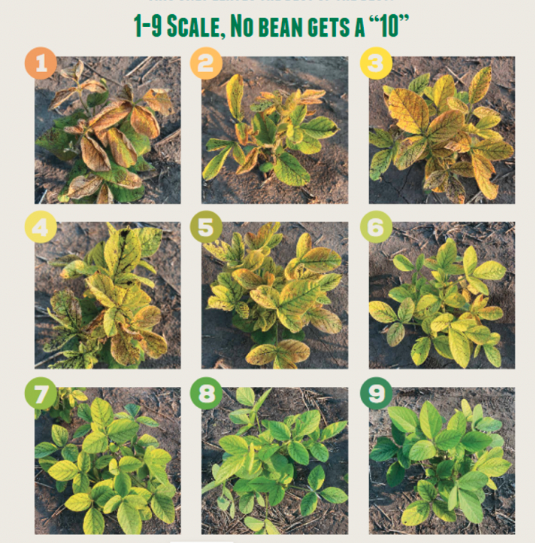
Iron deficiency chlorosis (IDC) is rarely an all-or-nothing problem. It shows up in pockets, changes with weather and can quietly limit yield potential before a crop ever has a chance to recover.
That’s why IDC tolerance shouldn’t be treated as a fixed number on a variety sheet, especially in fields where chlorosis has shown up before.
For growers farming IDC-prone ground, confidence comes from knowing how a variety performs under real field stress, not just how it looks in a trial summary.
IDC Is Driven by the Field, Not the Calendar
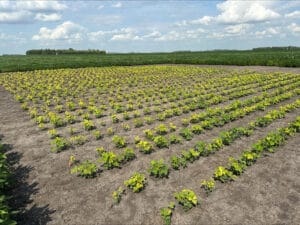
The Peterson Research Team plants IDC hills one foot apart to form the plot.
IDC pressure is tied to soil conditions and early-season stress. High pH, carbonates, salts, drainage challenges, manure history, and cool, wet starts all play a role. Two varieties planted side by side can respond very differently, and even the same variety can behave differently from one year to the next.
That variability is what makes IDC so frustrating, and why accurate placement matters.
Why We Screen IDC Performance Mid-Season
IDC ratings are inherently challenging. Pressure isn’t uniform, and controlled environments don’t always capture what happens in real fields. That’s why we augment annual IDC ratings every summer by verifying performance directly in IDC hot spots, during the growing season.
As IDC symptoms emerge, our team identifies those high-pressure zones within fields. We then mow those areas down and plant hills of soybean test varieties directly into confirmed IDC soil.
This side-by-side approach allows us to clearly see:
- Which varieties yellow early but recover
- Which stay chlorotic and never catch up
- Which tolerate stress and maintain growth
Because these hills are planted directly into active IDC pressure, differences show up quickly and clearly. If performance doesn’t match expectations, IDC scores can be adjusted to better reflect real-world behavior.
This kind of in-season IDC screening is unique, and it’s a key part of how we build confidence in the ratings growers use to make decisions.

Individual hill plots with 7 seeds each express the right amount of varietal tolerance. With 1-2 seeds per hill, plants will die and with 11-12 little visual symptoms will be seen.
What This Means for Variety Placement
IDC tolerance is not about eliminating chlorosis entirely. It’s about:
- Reducing severity
- Improving recovery time
- Protecting early vigor and yield potential
Using updated, field-verified IDC scores helps growers:
- Avoid placing sensitive varieties on high-risk acres
- Match stronger tolerance to known problem fields
- Reduce surprises early in the season
IDC tolerance is relative, not absolute. The goal is to make smarter placement decisions before the planter rolls.
The Takeaway
IDC doesn’t affect every acre, but when it shows up, it matters. By screening IDC performance mid-season, we ensure the data growers rely on reflects real conditions in real fields.
If your farm has fields with a history of chlorosis, updated IDC scores and local observations can help reduce risk and protect yield potential where it counts most.
Visit peterson.ag to see the latest IDC scores and placement guidance, or find your local Peterson territory manager to talk about IDC-prone fields on your farm.